What is Risk Allocation?
The key to a consistent framework that ties together all parts of the portfolio management process
How does it differ from traditional allocation practices?
| Traditional Allocation
|
Risk Allocation
|
||
| Allocate % of assets | Allocate % of risk | ||
| Focus on Returns | Focus on Risk Adjusted Returns | ||
| Allocations not responsive to market conditions | Allocations change with changing market conditions | ||
| Ex-post (historical returns) | Ex-ante (expected returns) | ||
| Instrument based | Volatility and Correlation based< | ||
| Constrained optimization | Eliminates corner solutions | ||
| Risk measured after the fact | Risk measured before events occur | ||
| Actual Risk varies widely with changing market conditions | Actual Risk held close to desired risk profile | ||
| Reactive | Proactive | ||
| Reconciles entrepreneur concentrations with portfolio diversification practice |
1/ Make an estimate of the expected return - and keep track of the estimates over time
But you are not a perfect estimator so as much as you like an opportunity you can't be sure and you start to diversify. " You may be a better estimator in one class of opportunities than in another class. While you would naturally favor that class, you would not want to totally exclude the other class. " You also try to spread your investments among desirable opportunities so that if something bad were to happen to one, the loss would only be proportional.
The problem is that most opportunities are linked and respond to varying degrees to the same external driving forces.
Simply stated, Marginal Sharpe says to add an opportunity until its correlation with the existing portfolio (including that opportunity) is equal to its Relative Sharpe.
This is where we have to blend art with science. Because we may not be able to quantitatively measure our estimating error, much less our correlations, we may have to make reasonable estimates. But the estimates must be made in the context of understanding the true underlying mechanics outlined above. Only then will you have consistent estimates that are stable over time.
Even with the supporting data, the "devil is in the details". External events may not be reflected in systematic return estimates (i.e., elections). The correlation calculation may be dependant on the time frame used. Etc.
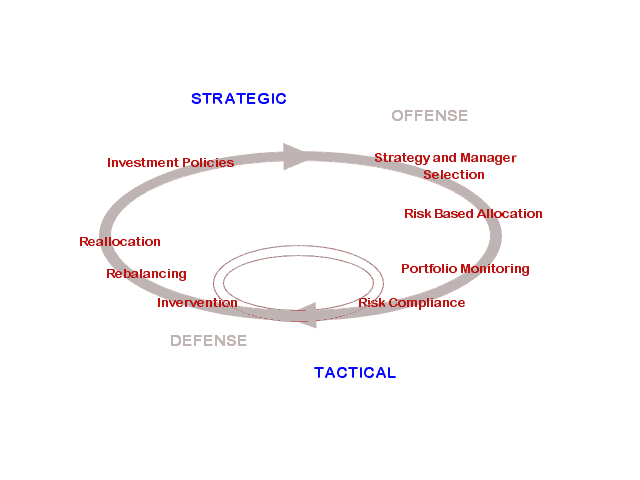
Strategy and Manager Selection then qualify available opportunities for inclusion in the portfolio and determine their risk characteristics. Risk Based Allocation quantifies the amount of risk to allocate to each opportunity in order to meet the targets and limits of the Investment Policies.
Having allocated various risks, Portfolio Monitoring measures the actual risk incurred at the aggregate portfolio level, within each allocation, and for a variety of sub-groupings (by asset class, by country, by credit worthiness, etc.).
Because the portfolio manager has allocated risk, he now has a metric against which to measure the observed risk. Risk Compliance provides a definitive picture of whether the portfolio meets the objectives and limits set by the Investment Policies. Note that in addition to being excessive, the actual risk may also be below the desired target levels.
If the risk is outside the acceptable range, the portfolio manager now has the tools to act proactively - before actually incurring an excessive loss. Depending on the severity of a risk mismatch, the manger may tactically Intervene to solve an immediate problem, may routinely Rebalance to bring allocations back in line, or may strategically Reallocate to reflect changing market conditions.
With the information gathered around the cycle, the Manager and the Investor are now in a better position to review the Investment Policies and make changes reflecting changing political and economic conditions, changing market conditions (volatility), and new instruments and strategies.
Each step around the risk allocation cycle supports and depends on all other steps. Together they work toward the ultimate goal of maximizing the return while adhering to the Investor's risk profile.